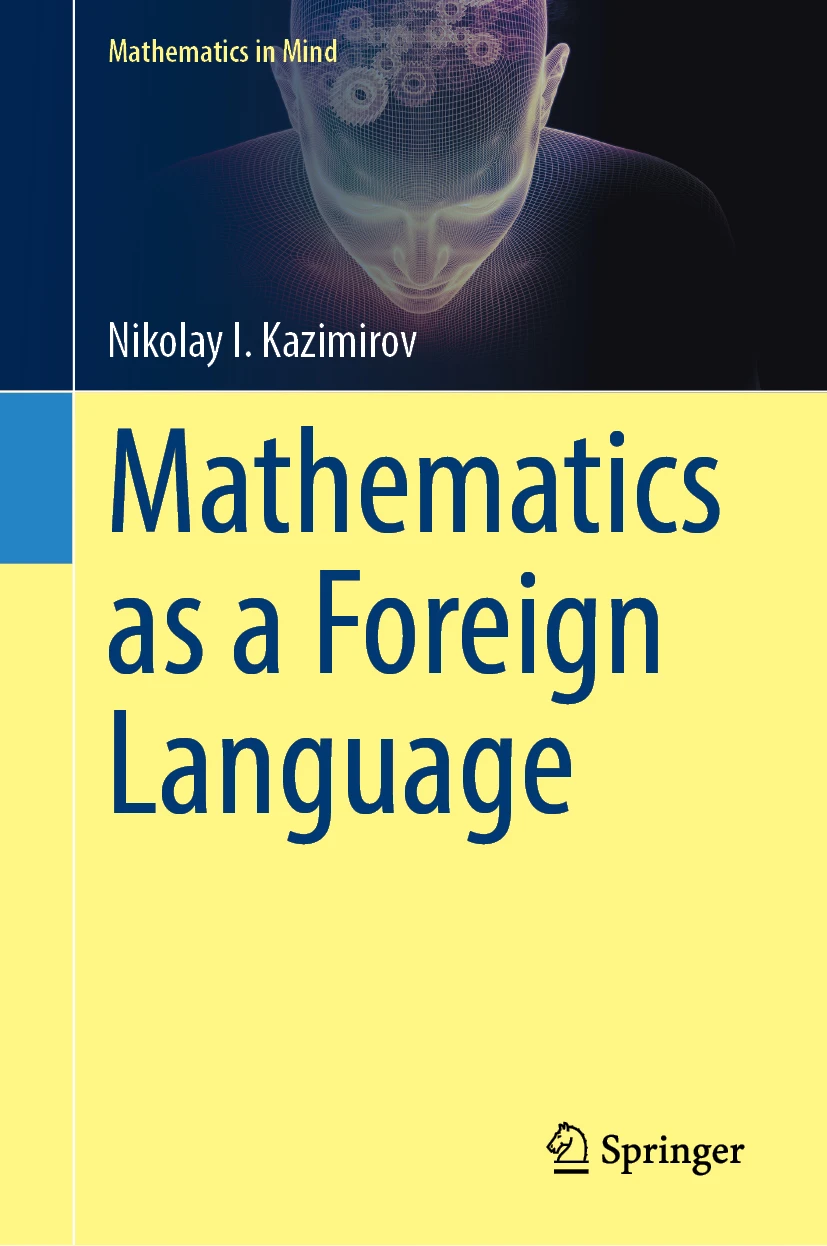
Mathematics as a Foreign Language — book cover
Springer · Monograph · 2026

Mathematics as a Foreign Language

The architecture of mathematical thought, taught like a language course.

A treatise on mathematics as a linguistic system — from the syntax of formulas to the semantics of formal theories — structured around five proficiency levels borrowed straight from language pedagogy: from A1 Survival to C1 A Mathematician's Paradise. This page indexes the book's structure, key results, notation, and terminology, with free digests of individual chapters.

Pre-order
Release date: September 17, 2026 · Author's original LaTeX typesetting available separately.
454
Pages (English edition)
~190
Exercises, with solutions
5
CEFR-style levels, A1–C1
22
Illustrations & portraits
§1

About the book

This text presents a distinctive pedagogical approach to the foundations of mathematics by treating the subject as a formal language to be learned. Its central thesis is that mastery of modern mathematics, logic, and computer science requires fluency in a precise and structured mode of thinking — an "architecture of thought" grounded in a rigorous and expressive language.

The book develops a method for learning mathematical language in a way aligned with contemporary foreign language pedagogy. It bridges the gap between intuitive understanding and formal rigor, complementing standard courses in logic, set theory, algebra, and philosophy.

Undergraduate students in mathematics, computer science, philosophy, and linguistics — as well as graduate students seeking a clear and structured review of foundational concepts — will find the book a valuable contribution to their understanding of mathematical formalism.

The text explicitly connects the formal language of mathematics with the operational logic of artificial intelligence. It includes approximately 190 exercises of varying difficulty, each accompanied by detailed solutions to support independent study.

"The algorithms controlling robots, neural networks analyzing data, and large language models generating text are all built upon the strict laws of logic and algebra that constitute the grammar of mathematics." — from the Preface.

A companion project, MathLogic Nexus, extends the book into an interactive 3D map of how definitions, theorems and theories connect across model theory, topology and computability — see the related Nexus Math project.

§2

Chapters & contents

Free digests of each level in Part I, The Ascent — start anywhere, like a language course, and skip what you already know. Part II, Proof-Theoretical Basis, is the book's topic-organized reference section: it doesn't get separate digests, but its structure is listed below for completeness.

Part I, The Ascent — the level course
A1
The alphabet of $\Math$: graphemes, the Matryoshka principle of lexeme construction, parse trees, predicates and terms, and why formal systems can "forget" their original semantics.
An Illustrative TaleThe Matryoshka PrincipleSemantics vs. SyntaxReflectionTerminologyVariables and BindingsFeatures of the Mathematical Language
A2
Concepts and their extensions, the birth of semantics, logic's relationship to naive set theory, valid inference, and a first rigorous look at relations and functions.
Concept"Truth" and "Falsity"Logic and SetsLogic and Semantics via Concept ExtensionLogical ReasoningConstructing InferencesOn Relations and Functions
B1
Propositional and predicate calculus properly formalized, model theory, interpretation, consistency and completeness, and the machinery of equality and congruence.
Propositional LogicPredicate Logic
B2
First-order Peano Arithmetic axiom by axiom, the first steps of set theory, and hereditarily finite sets as a sufficiently rich, self-contained finitary universe.
Peano ArithmeticProlegomena to Set TheoryHereditarily Finite Sets
C1
Zermelo–Fraenkel set theory in full, the Axiom of Choice and its equivalents, the von Neumann cumulative universe, and how mathematical structures get built.
Zermelo–Fraenkel Set TheoryThe Axiom of ChoiceThe von Neumann UniverseConstructions
Part II, Proof-Theoretical Basis (reference chapters, no separate digests)
D1
Language
Elementary Particles of LanguageLexemesSyntactic AnalysisSimplificationsGraphicsVariables
D2
Logic
Propositional LogicPredicate Logic
D3
Arithmetic
Basic PropertiesInductionElementary Theory of DivisibilitySequence CodingToward Gödel's and Tarski's Theorems
D4
Set Theory
Basic PropertiesFinite and Infinite SetsOrdinals and CardinalsThe Axiom of ChoiceOn the Interconnection of Formal Theories
Appendix — Solutions to all ~190 exercises
§3

Key results across the book

Level A1 · the book's core idea
The Matryoshka Principle
A lexeme of $\Math$ is, first, any independent grapheme; second, the result of substituting lexemes into a dependent grapheme's placeholders.
\[(a+b)+(c\cdot d)\]
Every well-formed expression, however deeply nested, is assembled this way — and can be unambiguously parsed back down.
Level A1 · reflection
A language that can describe itself
$\Math$ can talk about its own lexemes and formulas via a metalanguage — the same capacity for reflection that, applied to arithmetic through Gödel numbering, produces sentences that speak about their own provability, and ultimately the Incompleteness Theorems.
Level A2 · logic and sets
Logic and sets are the same coin
Every logical connective used to define a concept corresponds exactly to a set-theoretic operation on its extension: $\land$ and $\cap$, $\lor$ and $\cup$, $\neg$ and complement — and, more subtly, $\to$ corresponds to $(\mathcal U\setminus V_1)\cup V_2$.
Level B1 · completeness of predicate logic
Consistent, exactly when satisfiable
Gödel's Completeness Theorem as a single criterion: a theory is consistent if and only if it has a model. Gödel proved the substantial direction, consistent $\Rightarrow$ satisfiable, by building a model from the language's own terms; the converse follows trivially from soundness.
Level B2 · Peano Arithmetic
The Axiom of Induction
The last and strongest of the $\PA$ axioms:
\[\varphi[a/0]\land\forall x\,(\varphi[a/x]\to\varphi[a/Sx])\to\forall y\,\varphi[a/y]\]
Everything else in the theory — commutativity, order, divisibility — is derived from this schema plus six short lines about $0$, $S$, $+$, $\cdot$ and $<$.
Level B2 · hereditarily finite sets
A whole universe from three axioms
On top of extensionality, $\HF$ needs only pairing, union and power set to exist:
\[\exists X\,(X=\{a,b\}),\quad \exists U\,(U={\textstyle\bigcup} a),\quad \exists P\,(P=\Pcal(a))\]
— and from these, every finite mathematical structure can be coded as a set built from $\emptyset$ alone.
Level C1 · the Axiom of Choice
Three faces of one axiom
In $\ZF$, the following are provably equivalent: (1) the Axiom of Choice; (2) Zermelo's theorem — every set can be well-ordered; (3) Zorn's Lemma — a poset in which every chain has an upper bound has a maximal element. Same content, three completely different intuitions.
Level C1 · ordinals
Membership is order
For ordinals, $\in$ and $\subsetneq$ coincide:
\[\forall\alpha,\beta\,\bigl(\alpha\in\beta\leftrightarrow\alpha\varsubsetneq\beta\bigr)\]
which is why the class $\Ord$ is well-ordered by $\in$ — and why transfinite induction and recursion along $\Ord$ come for free.
§4

List of notations

A selection from the book's ~103 registered symbols; the full list ships with the printed edition.

Logic & quantifiers
\(\neg\ph\)Negation
\(\ph\land\psi\)Conjunction (AND)
\(\ph\lor\psi\)Disjunction (OR)
\(\ph\to\psi\)Implication
\(\forall x\;\ph(x)\)Universal quantifier
\(\exists x\;\ph(x)\)Existential quantifier
\(\vdash\)Syntactic derivability
\(\Vdash\)Logical (semantic) consequence
\(\models\)Truth in a model
Theories
\(\mathsf{PA}\)Peano Arithmetic
\(\mathsf{ZF},\ \mathsf{ZFC}\)Zermelo–Fraenkel set theory, with Choice
\(\mathsf{HF}\)Hereditarily finite sets
\(\mathsf{AC}\)Axiom of Choice
\(\mathsf{CH}\)Continuum Hypothesis
Sets, ordinals & cardinals
\(\{x\mid\ph(x)\}\)Set comprehension
\(\Pcal(A)\)Power set of \(A\)
\(\langle a,b\rangle\)Ordered pair
\(\om,\ \aleph_0\)First infinite ordinal
\(\Ord\)Class of all ordinals
\(\vert A\vert\)Cardinality of \(A\)
Relations & functions
\(f:A\to B\)Function from \(A\) to \(B\)
\(\dom(f),\ \ran(f)\)Domain, range of \(f\)
\([a]_R\)Equivalence class of \(a\) under \(R\)
\(\Agot\isom\Bgot\)Structures \(\Agot,\Bgot\) are isomorphic
§5

Bilingual terms glossary

Because the book treats mathematical vocabulary as vocabulary, here is a sample of it in both languages the site is published in.

Graphemeграфема
Lexemeлексема
Matryoshka principleпринцип матрёшки
Parse treeдерево разбора
Syntax / Semanticsсинтаксис / семантика
Reflectionрефлексия
Metalanguageметаязык
Concept, extension ofобъём понятия
Propositional logicлогика высказываний
Modus Ponensправило Modus Ponens
Deduction Theoremтеорема о дедукции
Gödel's completeness theoremтеорема Гёделя о полноте
Model of a theoryмодель теории
Congruenceконгруэнтность
Peano Arithmeticарифметика Пеано
Hereditarily finite setsнаследственно конечные множества
Axiom of Choiceаксиома выбора
Zorn's Lemmaлемма Цорна
Well-orderingвполне упорядочение
von Neumann natural numbersнатуральные числа фон Неймана
Ordinalординал
Cardinalityкардинальность
§6

The A1 → C1 ladder

Digital companion

MathLogic Nexus is an interactive 3D visualization of the logical dependencies between definitions, theorems and theories referenced in the book — a live map of the "architecture" of mathematical thought, connecting it to model theory, topology and computability. Explore it at nexus.mathem.at.

§7

About the author

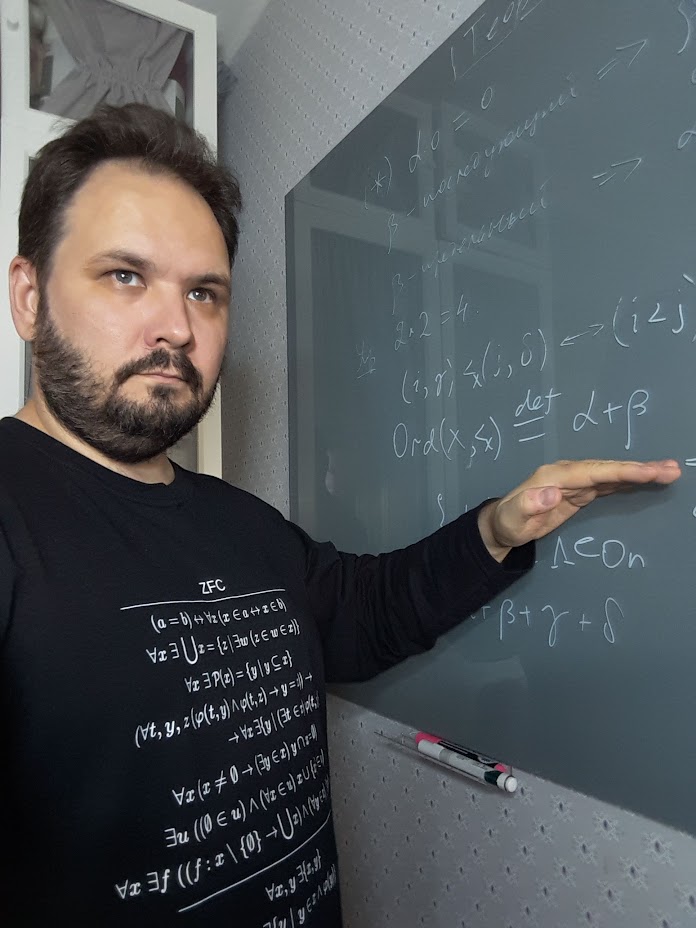
Nikolai I. Kazimirov
Nikolai I. Kazimirov, Ph.D.
Ph.D. in Mathematics. Graduated from the Faculty of Mathematics at Petrozavodsk State University and postgraduate studies at the Karelian Research Centre RAS. Learning German at TU Graz (Austria) inspired him to write this book. He specializes in foundations of mathematics, model theory, and the popularization of science.